

Contact Lenses
Best Contact Lenses
Contact lenses have been improving steadily in comfort and optics due to the competition of commitment between manufacturers. These advances are due to innovation in lens materials with better comfort through in-built lubrication, higher oxygen transmission and moisture content. Our visual demands increase with the years passing us by and also with the need to have a youthful outlook – these have also innovated newer optical designs in contact lenses and refractive surgery.
Contact lenses like refractive surgery free you from glasses. The feeling of being unencumbered is to be experienced by those who have worn glasses most of their lives. They work best with single vision. Multifocal designs are available and are still evolving. Advanced presbyopia still proves challenging.
Our Optometrist fits all available brands and modalities ranging from gas permeables, daily, weekly or monthly disposables to annual custom-made contact lenses including orthokeratology, keratoconus, scleral lenses. As an independent we strive to fit lenses that are best for our patients’ eyes. Sometimes, we prescribe one brand for one eye and another for the other eye.
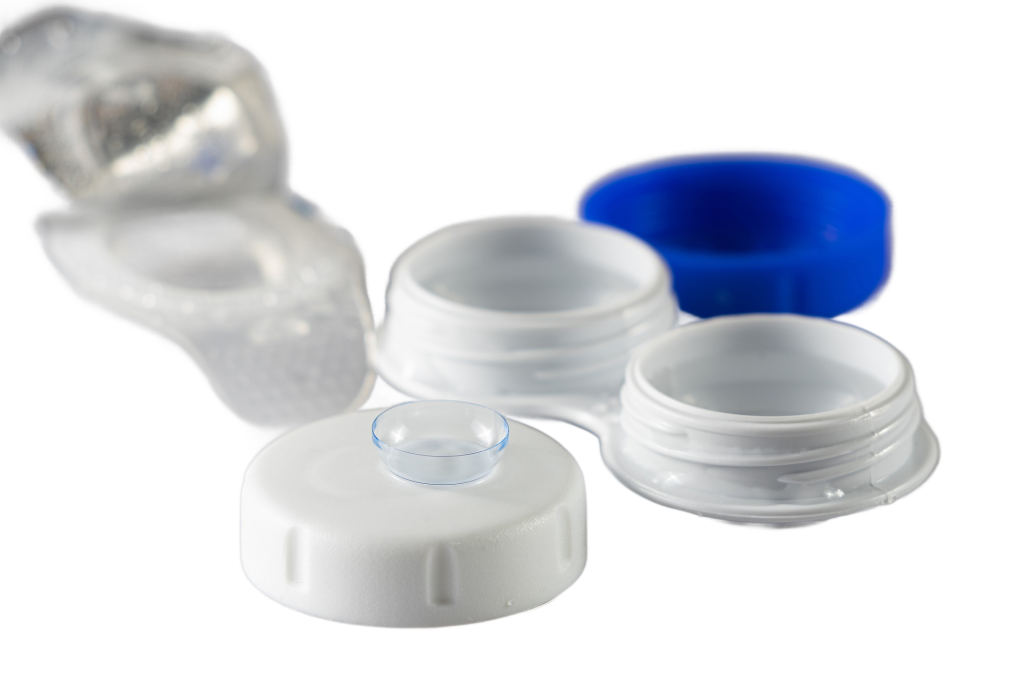
Contact Lens Fitting

The youngest contact lens patient fitted by our Optometrist was a 2-year old fitted with special rigid contact lenses for kerataconus ( a condition where the cornea progressively thins). There are multitudes of Contact lens types available: hard and rigid gas permeable lenses, soft lenses, disposable lenses, keratoconic lenses, orthokeratology lenses, hybrid and scleral lenses. Our optometrist works with all types and brands of contact lenses but most importantly what is best for the patient’s vision and acceptance is what decides the final fitting. Custom-made bespoke contact lenses whether in single vision, astigmatism and/or multifocal form our optometrist works closely with the manufacturing laborator to fine-tune the final contact lens design and optimal lens optics for each patient/contact lens wearer. It is not just the brand that is important, it is what is best for individual eyes. Our optometrist’s aim is to achieve optimal vision, comfort and longterm eye health with contact lens wear. In order to achieve this continued research and education is required to select from different contact lens manufacturers who are continually researching and developing materials, optics and contact lens solutions to optimize for individual requirements – all these principles also apply to those patients who have their cataracts replaced by intraocular lenses.
When fitting contact lenses most practices use a keratometer to measure the curvature of the cornea and the astigmatism, we go further using a topographer to create a 3 D map of the cornea to show areas of flatness and steepness in order to select suitable contact lenses.
Contact Lens Examinations

Despite contact lenses having developed and evolved over past decades, they should still be treated and respected as being foreign objects on the eyes. A contact lens fits over the cornea which is on average 550 microns (or 0.5mm) thick or in reality only half a mm! In comparision, the diameter of human hair varies from 0.04mm to 0.12mm. Scarring of the cornea from infections or physical damage affects clarity of sight for life i.e. permanently; hence regular contact lens checks are advised to prevent any potential sight-threatening problems. Poorly fitted or over worn contact lenses and even poor hygiene could lead to corneal erosion, infection or worst case scenario corneal exhaustion. During the Contact Lens Examination, the health of the anterior clear portion of the eyes (=window/front/cornea of the eyes) the fitting as well as the vision with contact lenses on are assessed. During this examination the health of the eyelids and tears are also assessed; Dry Eye Disease (DED) may also be identified. Our Dry Eye or Blepharitis Clinic assessment will get to the root of the problem giving us a wide variety of management and/or treatment options.
During the examination our slitlamp (microscope) is fitted with a digital camera and we are able to capture images of the cornea.